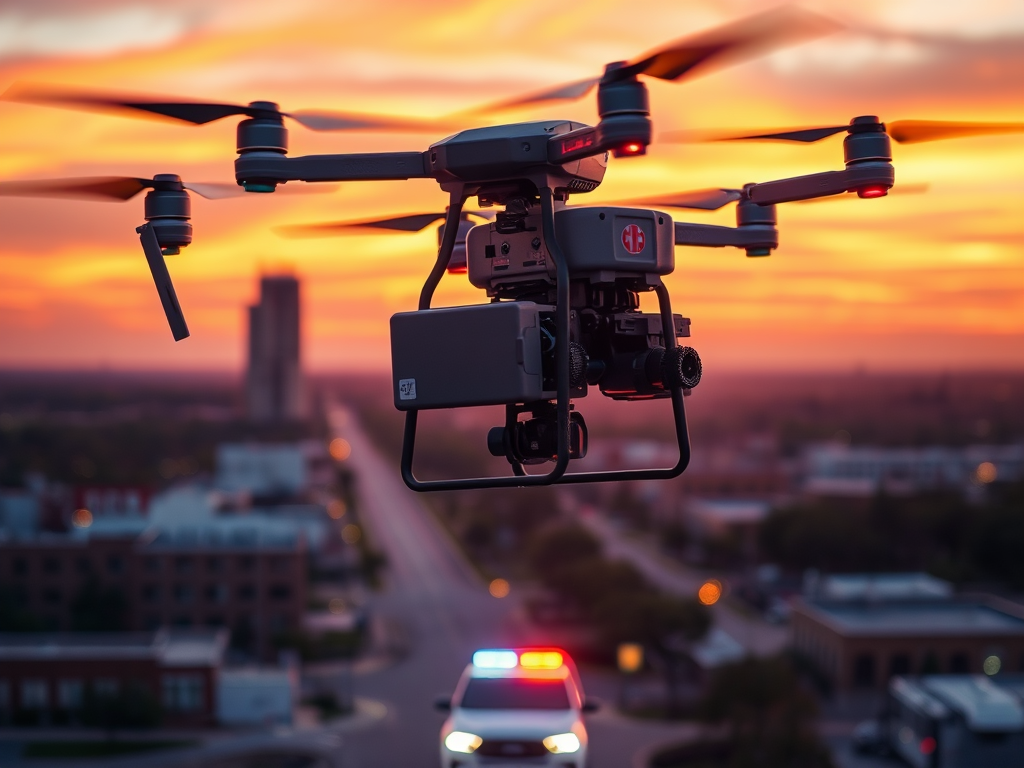
First Responders / Police
During a seven‑week trial, the Orlando Police Department used a single Skydio drone to respond to 185 calls. The drone arrived before officers roughly 33% of the time and provided useful information in 97% of those calls. Consequently, the city plans to buy 11 Skydio drones under a four‑year, $6.8‑million contract and integrate them into the department’s Crime Center. FAA‑licensed pilots will deploy drones to life‑threatening incidents, major property damage, or the imminent escape of a suspect, aiming for response times under three minutes. Because Florida bans Chinese‑made DJI drones, the American‑made Skydio units offer high‑definition and thermal imaging while complying with state laws. Additionally, privacy safeguards prohibit facial recognition or license‑plate scanning, and data will be retained only under public records requirements.
Read More
Commercial Expansion
Walmart aims to dramatically expand its Wing‑powered drone delivery service across the U.S. The retailer intends to cover more than 270 stores by 2027, extending its reach to urban and suburban markets. Consequently, the expansion is designed to meet growing demand for rapid delivery of essential items and will integrate drones into Walmart’s logistics system to shorten preparation and delivery times. Wing’s next‑generation drones promise precise, reliable flights and help reduce traffic congestion while increasing customer convenience. However, technical limitations, airspace rules, and high operating costs remain challenges, yet Walmart believes the benefits of speed and efficiency outweigh the risks. Current drone delivery sites include Dallas‑Fort Worth, Atlanta, Los Angeles, Miami, Cincinnati, St. Louis, Chicago, Orlando, and other cities.
Read More
U.S. Politics
A recent DRONELIFE report highlights a U.S. Government Accountability Office blog post warning Congress that drone delivery services are scaling rapidly. The GAO says the industry needs stronger safety frameworks. It explains that beyond‑visual‑line‑of‑sight operations will drive growth. These flights raise complex concerns about airspace integration, detect‑and‑avoid technology, and coordinated oversight. Although the blog does not propose new regulations, GAO’s scrutiny signals that lawmakers are watching and may hold hearings or request updates. Moreover, the post underscores the need for reliable detection systems, data transparency, performance standards, and agency coordination before nationwide drone delivery can proceed. As the FAA develops a BVLOS rule, GAO’s emphasis on institutional confidence suggests that scaling deliveries will require measurable safety performance.
Read More






Leave a Reply